ARTWORK PREPARATION · MAHJONG SHUFFLER CARDS
Custom Mahjong Shuffler Card Artwork: A Print-Ready Preparation Guide
Coordinate the product brief, template, authorized artwork, packaging, proofs, and physical sample before bulk production.
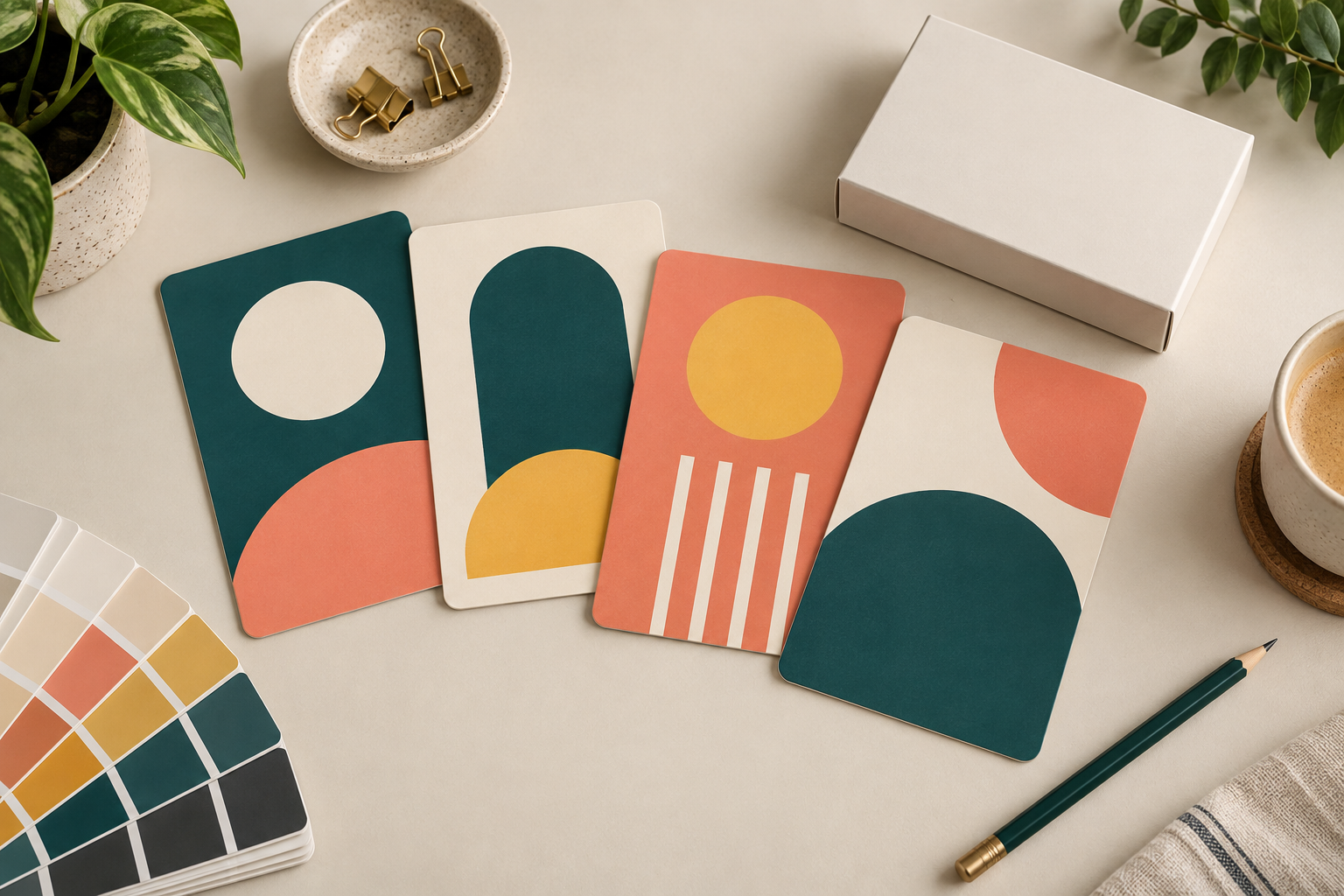
Prepare custom Mahjong shuffler card artwork only after the product specification and current production template are confirmed. Strong artwork files identify the front and back clearly, keep important content away from trim-sensitive areas, use original or authorized assets, define colors without ambiguity, and coordinate the cards with their packaging.
Mahjong shuffler cards are handheld table accessories used in place of bare palms when players mix face-down tiles. Players move the cards through the tiles by hand, adding color and a playful shared action. They do not shuffle tiles automatically.
Confirm the product brief before designing
Artwork should follow the physical product, not define it by guesswork. Before final design begins, confirm the intended user and channel, finished size and shape, number of cards per set, design count, front and back appearance, material and surface expectations, packaging format, total quantity, destination, and target timing.
This brief gives the supplier enough context to confirm what is feasible before the designer builds production files.
Request the current supplier template
A supplier template may identify the finished edge, bleed, safe area, orientation, and other production notes. Request the current template for the confirmed specification instead of copying an older file or estimating dimensions from a photograph.
- Keep the template scale unchanged.
- Preserve guides on a separate non-printing layer when possible.
- Confirm which side is the front and which is the back.
- Check the required color mode, file format, linked images, and font handling.
- Ask before changing the artboard, corner shape, or production marks.
- Name every file and version consistently.
Use only original or authorized artwork
Every photograph, illustration, pattern, icon, logo, typeface, phrase, and decorative element should be original, licensed, or otherwise authorized for the intended commercial use. Do not copy a third-party product, recognizable protected layout, trademark, character, artwork, or branded visual system.
Build a Mahjong-inspired look through original color, abstract geometry, custom lettering, or buyer-owned motifs. Keep an approval record for logos, licensed assets, commissioned illustrations, and fonts. If authorization is unclear, replace the asset before sampling.
Plan the front and back as one system
The front and back should feel like parts of the same product. Decide which side carries the main identity, how orientation remains obvious, how variations share one structure, and how the complete set looks when arranged together.
Avoid placing important text or a critical logo too close to an edge. Small trimming or finishing variation can make edge-dependent layouts look uneven.
Protect important content with bleed and safe areas
Bleed extends background color or imagery beyond the finished edge. The safe area keeps important text, logos, and focal details away from trim-sensitive edges. Follow the values supplied for the project rather than using generic measurements.
During preflight, inspect borders, thin lines, small text near corners, front-to-back orientation, artwork hidden under guides, and accidental white gaps or transparent objects.
Make text and logos reproducible
Review spelling, capitalization, dates, contact details, product names, and brand statements at the finished size. Use fonts with appropriate commercial rights, supply fonts or convert text as requested, avoid fragile strokes, confirm logo clear space, and keep an editable master file.
Do not add unsupported safety, quality, material, performance, certification, or age-suitability claims. Product statements should match the approved specification and sample.
Define color and surface expectations clearly
Screen color is not a reliable promise of printed color. Displays, substrates, inks, coatings, lighting, and surface treatments can change the final appearance. Provide requested color references and identify brand-critical colors.
Gloss, reflection, texture, contrast, and handling should be evaluated on the actual sample under realistic lighting.
Coordinate card artwork with packaging
Packaging should identify and protect the product without contradicting the cards inside. Confirm the packaging style and current dieline, cards per set, product name, visual system, buyer-supplied information, inner packing, carton organization, and how versions are distinguished during packing.
The card artwork, package artwork, proof, sample notes, and packing specification should use the same version names.
Build a clean production file package
Include editable artwork in the requested format, linked images, authorized fonts or outlined text as requested, clearly labeled front and back files, separate approved design versions, the current template, a visual reference, a written specification, packaging artwork, and an approval contact.
Use filenames that identify the product, side, design code, language, and revision. Archive obsolete versions separately.
Review digital proofs and a physical sample
A digital proof helps check layout, spelling, orientation, placement, and version matching. It cannot fully show material feel, surface appearance, color under real lighting, edge quality, handling, or packaging fit.
Review the physical sample as a complete set. Check finished size and shape, front and back orientation, artwork crop, print clarity, small text, logo reproduction, surface appearance, handling during the intended motion, consistency, package fit, component count, and version matching.
Plan MOQ and timing as conditional references
Custom MOQ is confirmed by inquiry because size, material, printing, finishing, number of designs, packaging, and quantity affect production planning. For ready-stock products, 5 sets is the current planning reference, subject to availability and final confirmation.
A regular custom sample is commonly around 10 days after specifications and production-ready artwork are confirmed. Regular bulk production for shuffler cards is commonly around 10–15 days after required approvals are complete.
These are conditional planning references, not fixed delivery promises. Actual timing depends on specifications, artwork readiness, processes, quantity, scheduling, sample feedback, revisions, approvals, and unexpected circumstances. Transportation time is additional.
Custom Mahjong shuffler card artwork checklist
- Intended user and channel
- Finished size, shape, and set quantity
- Material and surface expectations
- Current supplier template
- Original or authorized artwork
- Clearly labeled front and back files
- Bleed and safe-area check
- Fonts, links, and image quality
- Color references
- Packaging format and dieline
- Matched card and package versions
- Quantity and artwork-version count
- Sample reviewer and approval process
- Destination and target timing
Frequently asked questions
What artwork should I provide for custom Mahjong shuffler cards?
Provide clearly labeled front and back artwork based on the current supplier template, linked images, authorized fonts or outlined text as requested, color references, packaging artwork, a visual reference, and a written specification summary.
Should I design before receiving the production template?
You can develop the visual concept first, but final production artwork should use the current template for the confirmed size, shape, and construction.
Can every card in a set have different artwork?
Coordinated variations may be possible, but design count can affect preparation, sampling, production planning, and custom MOQ. Confirm it before finalizing files.
How should I handle copyrighted or trademarked artwork?
Use only assets that are original, licensed, or authorized for the intended commercial use. Replace any asset whose rights are unclear.
Is a digital proof enough?
No. A physical sample is recommended for checking print, color, surface, edge appearance, handling, set consistency, and packaging fit.
What is the MOQ for custom Mahjong shuffler cards?
Custom MOQ is confirmed by inquiry because size, material, printing, finishing, design count, packaging, and quantity affect production planning. Ready-stock products currently use 5 sets as a planning reference, subject to availability and confirmation.
How long do custom shuffler cards take?
A regular sample is commonly around 10 days, and regular bulk production is commonly around 10–15 days. These are conditional references, and transportation time is additional.
PREPARING CUSTOM ARTWORK?
Share your shuffler-card project brief.
Send the intended use, specification, authorized artwork status, number of designs, packaging idea, quantity, destination, and target timing for a practical sample and production review.
Start a project discussion ->Plan a custom retail shuffler-card project.